How to Estimate Total Fabric Cost for Any Sewing Project
Know your total fabric cost before you buy. This guide covers how to calculate material costs for curtains, quilts, clothing, and upholstery, including hidden cost factors.
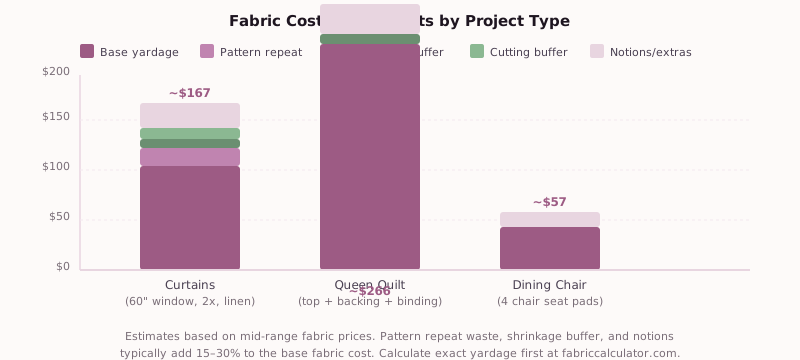
Total fabric cost is one formula most sewists never write down: yardage needed × price per yard, plus notions and thread. What inflates that total is the set of numbers the tag doesn't advertise. Pattern repeats, shrinkage buffers, and cutting waste commonly add 10 to 25 percent on top of the base fabric cost. That's the gap between the number you imagined at the store and the receipt you take home.
Fabric cost surprises are common. You go in expecting to spend $80 and leave spending $150. Or you order online, underestimate yardage, and pay a second shipping charge for the extra yard you need.
Planning the fabric budget before you buy is straightforward once you know what drives cost beyond the simple yardage × price math. This post breaks it down for every major project type.
The Basic Formula
Total Fabric Cost = Yardage Needed × Price Per YardSimple enough. The complexity is in calculating "yardage needed" accurately.
Our fabric yardage calculator returns the minimum calculated yardage. Add your buffers (pattern repeat, shrinkage, cutting waste) to that number before multiplying by price per yard.
Working example:
- Project: two panels of linen curtains, 60-inch window, 84-inch drop, 2x fullness, 54-inch fabric
- Calculated yardage: 10.3 yards
- Pattern repeat (18-inch): rounds up cut length, adds ~0.8 yards → 11.1 yards
- Shrinkage buffer (8 percent for linen): 11.1 × 1.08 = 12 yards
- Cutting buffer (½ yard): 12.5 yards total
- Price per yard at $22: $275
The initial guess many would make ("it's curtains, maybe 8 yards at $22" = $176) undershoots by $99.
Fabric Cost by Project Type
Curtains and Drapes
Curtain fabric cost depends heavily on fullness ratio, panel length, and window width. What to expect for a standard 60-inch window at mid-range pricing ($15 to 25/yard for decorator fabric):
| Fullness | 84-inch drop | 108-inch drop |
|---|---|---|
| 1.5x | $90 to 150 | $115 to 190 |
| 2x | $120 to 200 | $155 to 260 |
| 2.5x | $150 to 250 | $195 to 325 |
These are per-window estimates. A room with four windows scales proportionally. Add pattern repeat costs if applicable.
The most accurate way to budget: calculate yardage with the curtain fabric calculator, then add 10 to 15 percent for your buffer, and multiply by your target price per yard.
Quilts
Quilt costs are more complex because most quilts use multiple fabrics. A simplified breakdown for a queen quilt (90×100 inches) using mid-range quilting cotton at $12 to 15/yard:
Simple 2-fabric quilt:
- Top fabric: 8.5 yards + 10 percent buffer = 9.4 yards
- Backing (44-inch): 9 yards + buffer = 10 yards
- Binding: ¾ yard
- Total fabric: ~20 yards
- Cost range: $240 to 300
10-fabric patchwork quilt:
- Assume each of 10 fabrics averages 1 yard (varies by design)
- Plus backing (9 yards) and binding (¾ yard)
- Total fabric: ~20 yards
- Cost range: $240 to 300
The fabric totals are similar. Patchwork quilts use smaller amounts of many fabrics rather than large amounts of few. The key difference is time, not cost.
Calculate each fabric separately and sum the totals. For full quilt-yardage breakdowns by size, see our quilt yardage guide.
Garments
Garment fabric cost is straightforward if you follow the pattern's yardage requirements. A few notes:
- Patterns list yardage for a specific width (often 45-inch and 60-inch options)
- Use the wider fabric's yardage if buying 60-inch fabric; it's usually less
- Add 10 percent for directional prints, plaids, and stripes that require matching
- Common woven fabric: $8 to 20/yard for cotton, linen, lightweight wool
- Specialty fabric (silk charmeuse, Italian wool, stretch denim): $20 to 60/yard
- Lining (if needed): add ½ to ¾ the fabric yardage at $5 to 10/yard
A simple dress (3 yards at $15/yard): ~$45 for fabric.
A tailored jacket with lining (4 yards fashion fabric + 2 yards lining): $100 to 250 or more depending on fabric choice.
Upholstery
Upholstery fabric costs are the highest of any home sewing project. High-quality upholstery fabric costs more per yard, and large furniture requires many yards.
Dining chair seat pad (4 chairs):
- ~1.5 yards at $20 to 35/yard = $30 to 52
Accent chair (fully upholstered):
- ~5 yards at $20 to 35/yard = $100 to 175
3-seat sofa (tight seat and back, no cushions):
- ~13 yards at $25 to 45/yard = $325 to 585
3-seat sofa with loose cushions:
- ~18 to 20 yards at $25 to 45/yard = $450 to 900
Performance and stain-resistant fabrics cost $35 to 55/yard but last longer under heavy use, often the better value for seating.
Our upholstery fabric guide has detailed yardage breakdowns for each furniture type.
Hidden Cost Factors
Pattern Repeat Waste
Every cut past the first adds one full vertical repeat in waste. On a 24-inch repeat across 6 curtain panels, that's 2 to 4 yards of extra fabric, or $50 to $100 in hidden cost. Enter your repeat in the calculator and it's factored in automatically. Our pattern repeat guide has the full formula and worked examples.
Shrinkage Buffer
For cotton and linen, add 5 to 10 percent to account for first-wash shrinkage. You're buying fabric you'll wash away. At $20/yard, 10 percent extra on 8 yards = 0.8 yards = $16. Budget for it.
Cutting Waste
Even with perfect measurements, some fabric is wasted at every cut. Cutting around shaped pattern pieces (armholes, necklines, curved seat covers) wastes more than cutting rectangles. Budget an additional ¼ to ½ yard for straight-cut projects, 10 to 15 percent for garments, and 25 to 40 percent for complex upholstery. See our rundown of common buying mistakes for the buffers that catch most sewists off guard.
Thread, Zippers, and Notions
Fabric is usually the largest material cost, but notions add up:
- Thread: $3 to 8 per spool (you'll need at least 2 for a large project)
- Zippers: $3 to 8 each
- Buttons: $8 to 20 for a quality set
- Interfacing: $3 to 8/yard
- Batting (for quilts): $15 to 30 for a queen-size roll
- Drapery hardware (rods, rings, hooks): $25 to 80 or more per window
Budget $15 to 50 for notions on most projects. For quilts, add $25 to 35 for batting. For garments, add $20 to 40 for notions depending on closures.
Building Your Project Budget
- Calculate yardage with the fabric calculator for each material component
- Add buffers: pattern repeat, shrinkage (5 to 10 percent), cutting buffer (¼ to ½ yard)
- Multiply by price: research price per yard before committing
- Add notions: estimate based on project type
- Total: compare to your budget before you buy
If the total is higher than your budget, adjust fabric choice (a cotton-linen blend at $18/yard instead of pure linen at $28/yard), reduce fullness ratio on curtains, or simplify the design.
Knowing the real cost before you start prevents mid-project budget shock and helps you decide whether to splurge on the fabric you love or find a quality alternative that fits your budget.
Calculate your project yardage, then research prices at your preferred fabric retailer. Learn more about how we build our tools on the about page.