Pattern Repeats in Fabric: How They Add to Your Yardage
Pattern repeats mean you need more fabric than the finished size suggests. Learn how to calculate the extra yardage needed to align repeating designs across panels.
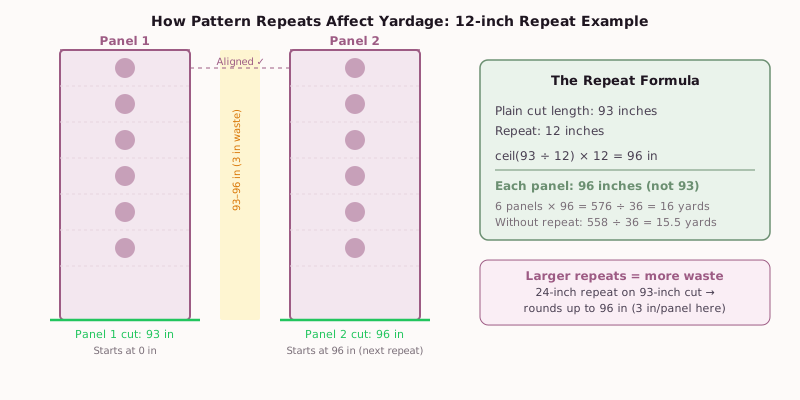
A common misconception is that a "12-inch repeat" only costs you a few inches of fabric. It doesn't. Add one full pattern repeat per cut after the first, and those inches multiply with every panel. On a 3-panel curtain set with a 12-inch repeat, you're adding 24 extra inches (2 repeats). Double that repeat to 24 inches on the same project and the penalty jumps to 48 extra inches, over a yard of fabric that exists only to make the flowers line up.
Pattern repeat is the feature of patterned fabric that trips up more fabric calculations than any other. The numbers seem small on the tag. Across multiple panels on a large project, though, the waste adds up to real yardage and real cost.
The good news is the calculation is completely predictable. Once you understand how repeat alignment works, you can work out the exact extra fabric needed before you buy.
What Is a Pattern Repeat?
A pattern repeat is the vertical distance (and horizontal distance) before a design element completes its cycle and starts over.
Vertical repeat: The distance from one point in the pattern to the identical point directly below it. For a stripe, this is the stripe interval. For a floral, it's the distance from one flower head to the next identical flower head in the same vertical position.
Horizontal repeat: The distance across the fabric before the pattern restarts. Less commonly relevant for yardage calculations; it matters more for matching patterns at vertical seams.
Straight match: The pattern repeats straight across each row. The same design element appears at the same horizontal position on every row.
Half-drop match: Alternate columns are offset by half the repeat height. This is common in floral and geometric designs. Half-drop matching means adjacent panels can't both start at the top of the repeat; one panel must start half a repeat lower.
The fabric calculator handles straight-match repeats. For half-drop repeats, add an extra half-repeat to the straight-match calculation as a buffer.
Why Pattern Repeats Affect Yardage
With a plain fabric, you can cut panels starting at any point on the fabric. The second panel begins where the first one ended.
With patterned fabric, you must start every panel at the same point in the repeat, typically the same design element (a flower head, the start of a stripe, the top of a medallion). This ensures that when two panels hang side by side, the pattern flows continuously.
If panel 1 starts at the top of the repeat (position 0) and is 93 inches long, panel 2 must also start at position 0 of the repeat. But panel 1's cut ended at 93 inches into the fabric. The next "position 0" in the repeat occurs at the next full repeat above 93 inches.
For a 12-inch repeat: the next repeat start above 93 is at 96 inches (the next multiple of 12). Panel 2 starts at 96 inches, not 93. Three inches wasted.
On 6 total panels: 6 × 96 inches = 576 inches (16 yards) versus 6 × 93 inches without repeat matching = 558 inches (15.5 yards). Half a yard difference on a 12-inch repeat.
Scale up to a 24-inch repeat:
- Each panel rounds up to the nearest 24-inch multiple above 93 = 96 inches
- Same result here, coincidentally. But on a panel that's 88 inches, the cut rounds up to 96 inches: 8 inches wasted per panel × 6 panels = 48 extra inches = 1.3 extra yards
The larger the repeat and the more panels you have, the more fabric the repeat adds.
The Formula for Repeat-Adjusted Yardage
The standard approach:
Repeat-Adjusted Cut Length = ceil(Cut Length ÷ Repeat) × Repeat
Total Yardage = (Adjusted Cut Length × Total Panels) ÷ 36
This is what our fabric calculator computes when you enter a value in the Pattern Repeat field. Enter the vertical repeat in inches; the calculator rounds each panel up to the nearest full repeat.
Example: 3-panel curtains with 24-inch repeat
- Finished drop: 84 inches
- Bottom hem: 8 inches
- Seam allowances: 1 inch
- Plain cut length: 93 inches
- With 24-inch repeat: ceil(93 ÷ 24) × 24 = 4 × 24 = 96 inches per panel
- Extra per panel: 3 inches
- Total extra for 6 widths: 18 inches = 0.5 yard
Example: 3-panel curtains with 18-inch repeat
- Plain cut length: 93 inches
- With 18-inch repeat: ceil(93 ÷ 18) × 18 = 6 × 18 = 108 inches per panel
- Extra per panel: 15 inches
- Total extra for 6 widths: 90 inches = 2.5 yards
That 18-inch repeat adds 2.5 yards. If fabric costs $25 a yard, that's $62.50 in extra fabric cost purely because of the repeat.
Reading Repeat Information on Fabric Listings
Fabric sold online and in stores lists repeat information as:
- "Repeat: 18V" (18-inch vertical repeat)
- "12-inch repeat" (usually vertical)
- "V: 18, H: 9" (18-inch vertical, 9-inch horizontal)
Sometimes the listing says "railroaded." That means the pattern runs horizontally across the width rather than vertically along the length. Railroaded fabric eliminates the need for vertical repeat matching on wide upholstery projects (like a sofa back) but creates different considerations for curtains.
If no repeat is listed for a clearly patterned fabric, contact the retailer or measure the fabric directly.
Pattern Repeats in Upholstery
For upholstery, pattern matching is even more involved than for curtains, because you're matching across adjacent surfaces on a three-dimensional form.
Basic rule: Each major upholstered surface (seat cushion, inside back, outside back, seat top) must have the pattern centered or consistently positioned. On a sofa, the pattern on the inside back should visually continue into the seat cushion.
Practical approach:
- Center the dominant design element on the most prominent surface (usually the center cushion seat or inside back)
- Work outward from that centerline
- Add one full repeat per cut for each piece that must match an adjacent piece
For detailed upholstery with large repeats, some professionals create a "cut sheet," a scaled drawing of each cut piece laid out on the fabric pattern, to minimize waste while ensuring matching.
See our upholstery fabric guide for how pattern repeats factor into the total yardage for different furniture pieces.
Pattern Repeats in Quilting
Quilting is somewhat different. Since the design is broken into small pieces, matching a large-scale print across the quilt requires strategic cutting rather than strict repeat alignment.
Fussy cutting: Cutting specific design elements from the center of blocks. A fabric with large roses might have a rose centered in each 6-inch block. Each fussy-cut block uses more fabric than a geometric cut because you're choosing where to cut, not just cutting sequentially.
For fussy cutting, the extra yardage needed depends on the repeat size and the block size. A general rule: double your calculated yardage for the fussy-cut fabric when the repeat is larger than your block size.
Large-scale quilting designs: If you're using fabric with a 12-inch motif in a quilt with 12-inch blocks, plan so the motif appears fully within the block border. This often requires cutting only 1 to 2 blocks per repeat rather than the 3 to 4 blocks that would fit on plain fabric.
How to Handle Pattern Matching Without a Calculator
If you're calculating by hand without a tool:
- Calculate the plain cut length (finished + hems + seams)
- Round up to the next multiple of the pattern repeat
- Multiply that adjusted length by the total number of panels
- Divide by 36 for total yards
For example: 93-inch cut length with 12-inch repeat rounds up to 96 inches. Six panels × 96 = 576 ÷ 36 = 16 yards.
Or enter the repeat into the fabric calculator's Pattern Repeat field and skip the arithmetic. Our guide to buying curtain fabric walks through a complete example with both plain and patterned fabric for the same window.