How Much Fabric Do You Need for Curtains?
Calculate curtain fabric yardage correctly with our step-by-step guide. Covers fullness ratios, pattern repeats, hem allowances, and common mistakes.
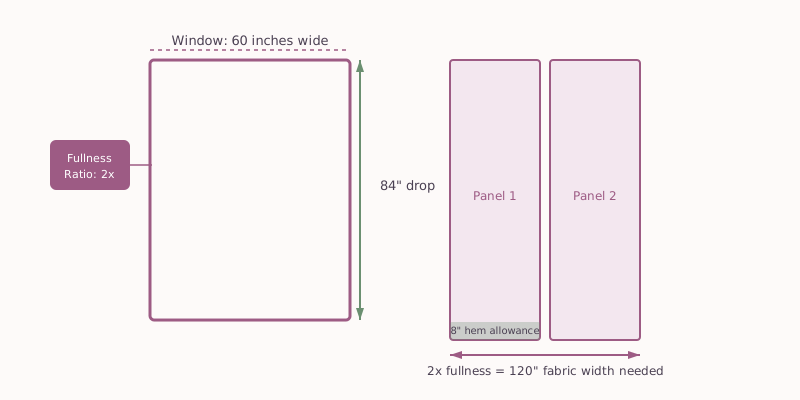
Picture this. You've measured a 60-inch window, walked into the fabric store thinking you need about eight yards, and walked out with ten to be safe. Two weeks later you're short by a yard and the bolt is gone. For a standard pair of curtains on a 60-inch window, realistic planning is 8 to 12 yards of 54-inch home décor fabric, and often more once fullness, drop, and hems are added in.
Curtain fabric is one of those purchases where a small miscalculation costs real money. Come home a yard short and the bolt may already be cut up. Overbuy significantly and you've spent $50 to $100 on fabric folded in a drawer forever.
The rest of this walks through the full calculation that professional workrooms use.
The Basic Formula for Curtain Fabric
Curtain yardage comes down to two dimensions: how wide and how long. Both get adjusted before you reach the fabric store.
Width calculation:
Fabric Width Needed = Window Width × Fullness Ratio
Panels Across = ceil(Fabric Width Needed ÷ Fabric Bolt Width)
Length calculation:
Cut Length = Finished Drop + Top Hem + Bottom Hem + Seam AllowancesTotal yardage:
Total Yards = (Cut Length × Total Panels) ÷ 36Take a 60-inch window at 2x fullness, using 54-inch home décor fabric with an 84-inch drop, a 4-inch bottom hem, and ½-inch seam allowances:
- Fabric width needed: 60 × 2 = 120 inches
- Panels across: ceil(120 ÷ 53) = 3 panels (53 = 54 minus 1 inch for seams)
- For 2 curtain panels, that's 6 total fabric widths
- Cut length: 84 + 8 (hem) + 1 (seams) = 93 inches
- Total: (93 × 6) ÷ 36 = 15.5 yards
Most people expect "about 8 yards" for that window. Reality is 15.5 yards, nearly double, once you account for fullness and proper hems. Skip any step and you'll be short.
What Is Fullness and Why Does It Matter?
Fullness is the ratio of fabric width to finished window width. More fabric means more gather, which reads as more formal and more lush.
A quick overview of each level:
1x fullness (flat): The fabric panel equals the window width. No gather at all. Works for sheer panels layered under drapes, Roman blinds, or a modern flat valance. Minimal by design.
1.5x fullness: A relaxed, casual gather. Standard for rod-pocket curtains, tab-tops, and cafe curtains. The cheapest option that still reads as "curtains" rather than a flat shade.
2x fullness: The classic curtain look. Rod-pocket, ring-clip, and grommet styles all look their best at 2x. Most residential workrooms default to this, and most curtain patterns are drafted for it.
2.5x fullness: Reserved for formal treatments: pinch-pleat, goblet, and box-pleat headers. The fabric hangs in structured, defined columns. You see this in dining rooms, formal living rooms, and hotel lobbies. It costs nearly double the fabric of a 1.5x treatment.
Going from 1.5x to 2.5x fullness on a 60-inch window adds about 60 inches of fabric width, which is 2 to 4 extra yards depending on panel height. Our curtain fullness ratio guide has the full breakdown of how each header style behaves, plus room-by-room recommendations.
Measuring Your Window Correctly
Before you calculate, you need accurate measurements. Two options: inside mount and outside mount.
Inside mount: Curtains hang inside the window frame. Measure the inside width and drop from the top of the frame to the desired bottom point. This gives a tighter, cleaner look but less coverage.
Outside mount: Curtains extend beyond the window frame on both sides. This is standard for most home décor curtains because it makes the window appear wider and lets in more light when the curtains are open. Add 3 to 6 inches on each side of the window frame for the rod extension.
For the drop, measure from where the rod will sit (usually 4 to 6 inches above the window frame, or right at ceiling height for drama) to your chosen endpoint: sill, below sill (apron length), or floor.
Most home décor curtains are floor-length. Standard drops are 84 inches, 96 inches, or 108 inches. For a "puddled" effect, add 6 to 12 extra inches to the drop.
Hem and Header Allowances
The finished measurements you measure are not the cut measurements. Every hem and seam allowance gets added to the cut piece.
Bottom hem: A standard curtain hem is a 4-inch double-fold, which means you need 8 inches added to the cut length. A narrower single-fold 2-inch hem needs only 2 inches. Puddle curtains skip the bottom hem entirely; the extra length simply pools on the floor.
Side hems: Each side panel typically gets a 1 to 1.5-inch double-fold hem. This matters when you're calculating how many panels fit across a fabric width.
Top heading: A simple rod pocket needs 3 to 4 inches turned and sewn. A pinch-pleat header uses buckram (stiffener) and needs 4 to 6 inches for the heading plus additional for pleating. Header tapes vary. Always check the tape manufacturer's instructions.
Seam allowances: Side and top seams are typically ½ inch each side. The calculator doubles these automatically.
For panels that will be joined across the width (when one fabric panel isn't wide enough), add ½-inch seam allowances where panels join.
Pattern Repeat: The Calculation Most People Miss
If your fabric has a pattern (stripes, florals, geometric repeats), each panel's cut length must align. You can't have the pattern starting in a different position on each panel. It looks immediately wrong when the panels hang side by side.
The fix: round each panel's cut length up to the nearest full repeat.
A fabric with a 12-inch repeat and a 93-inch cut length gets rounded up to 96 inches (the next multiple of 12). On 6 total panels, that's 18 extra inches, or half a yard. On a large-scale 24-inch repeat, the extra could be 2 to 3 yards.
That's why the fabric store might tell you to "add one repeat per panel after the first." Our pattern repeat guide explains how to calculate this without math errors, and our calculator handles it automatically when you enter your repeat in the Pattern Repeat field.
Common Mistakes That Leave You Short
Confusing the finished size with the cut size. The finished size is what you see when the curtains hang. The cut size is what you cut from the bolt. They differ by every hem and allowance you add.
Ignoring fullness. Buying "enough fabric to cover the window" without multiplying by fullness is a common miss. For a 2x fullness treatment, you need twice the window width in fabric.
Skipping the pattern repeat. Even a small 6-inch repeat adds inches per panel. On a large treatment, this can mean a full extra yard.
Not accounting for fabric width. A 54-inch bolt doesn't mean one panel fills a 54-inch window with fullness. Effective usable width per panel, after side hems, is around 52 to 53 inches. That's before you apply the fullness ratio.
Buying from a different dye lot. Fabric is dyed in batches, so if you run short and return for more, the new bolt may have a slightly different shade. Buy everything you need in one purchase.
Calculating Fabric for Multiple Windows
For multiple windows of the same size, multiply total yardage by the number of windows. For windows of different widths, calculate each separately and add the totals.
If your windows have the same drop but different widths, you can sometimes combine the width calculation and reduce cuts. Two 48-inch windows at 2x fullness need 192 inches of fabric width total, the same as one 96-inch window. You may be able to cut both from a single length.
Enter each window's dimensions into our fabric calculator to get exact yardage for every treatment in the room. It handles multiple panels, fullness ratios, and pattern repeats, so there's no spreadsheet required.
How Much Extra to Buy
Always add a buffer. For curtains:
- No pattern: Add ½ yard as a cutting insurance buffer
- Small repeat (under 12 inches): The calculator's repeat rounding covers you. Add ¼ yard extra.
- Large repeat (12+ inches): Add ½ yard on top of the calculated total
- Natural fibers (linen, cotton): Add 5% for shrinkage if you pre-wash the fabric. See our fabric shrinkage guide for exact pre-wash percentages by fiber type.
- Expensive or hard-to-source fabric: Add ¾ yard minimum as insurance
Leftover curtain fabric is never truly wasted. It makes pillow covers, tiebacks, and roman shades for the same room.
Ready to Calculate?
Plug your window width, drop length, fabric bolt width, and fullness ratio into the calculator. It returns exact yardage, cut length per panel, panel count, and a total cost estimate in seconds. More on our calculation method on the about page.