How Much Fabric for Upholstery? Chairs, Sofas, and Cushions
Calculate upholstery fabric yardage for dining chairs, accent chairs, sofas, and cushions. Includes pattern repeat adjustments and cutting layout tips.
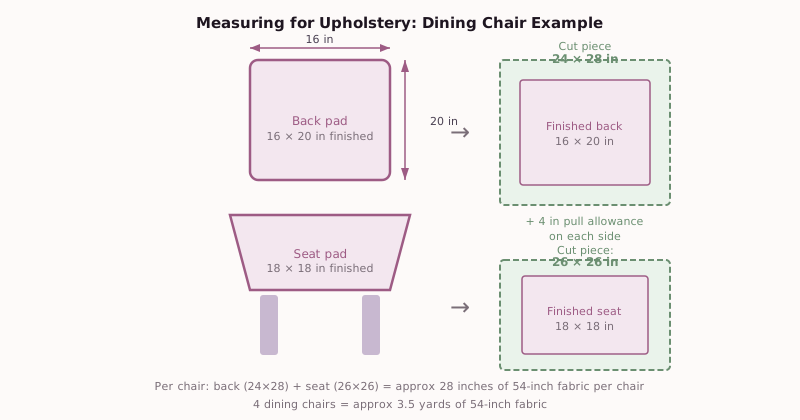
Most people underestimate how much fabric a sofa actually eats. A standard dining chair can be done with 1.5 to 2 yards of 54-inch fabric. Step up to an accent chair with arms and you're looking at 4 to 6 yards. A standard three-seat sofa? 12 to 18 yards, and that's before you factor in pattern matching, which can tack on another full pattern repeat for every horizontal seam.
Reupholstering furniture is one of the more complex fabric calculations in home sewing. Unlike curtains or quilts, upholstery wraps around three-dimensional shapes with curves, edges, and attachment allowances. Coming up short mid-project is genuinely difficult to fix, because upholstery fabric is sold by the yard and dye lots change.
This guide covers how to measure and calculate fabric for the most common upholstery projects: dining chairs, accent chairs, sofas, and throw cushions.
How Upholstery Fabric Calculation Differs from Sewing
Regular sewing calculates yardage based on finished dimensions plus seam allowances. Upholstery is different in three ways.
Pull and attachment allowances. Fabric must extend beyond the visible finished edge to wrap under the frame, around the cushion, or to a tacking point. This is typically 3 to 6 inches on every side, far more than a standard seam allowance.
Cutting layout efficiency. Upholstery pieces are rarely rectangles. Curved seat shapes, angled backs, and irregular arm shapes waste significantly more fabric than rectangular sewing projects. Factor in 25 to 40 percent cutting waste for most upholstery.
Pattern matching. A patterned upholstery fabric must align across all visible surfaces: front of seat to front of back, cushion top to cushion front, and so on. This can add 1 to 3 pattern repeats to your total, depending on scale.
Measuring for Upholstery
For every surface you're covering, measure the widest and longest points, then add 4 to 6 inches on each side for pull and attachment.
For a dining chair seat (drop-in seat cushion):
- Measure seat width at widest point
- Measure seat depth front to back at deepest point
- Add 4 inches on all sides: (width + 8) × (depth + 8)
- A typical 18×18-inch seat becomes 26×26 cut piece
For a dining chair back (upholstered pad):
- Measure back width and height separately
- Add 3 to 4 inches on all sides for the attached style
- A typical 16×20-inch back becomes 24×28 cut piece
For an arm chair or wing chair:
- Measure each section separately: seat, inside back, outside back, inside arm (×2), outside arm (×2), front arm (×2), seat cushion top, seat cushion front/back, seat cushion sides
- Create a cutting list with the exact cut dimensions for each piece
- Total all pieces to determine total yardage
Fabric Yardage by Furniture Type
Dining Chair (drop-in seat pad only)
For a standard dining chair with a removable drop-in seat, only the seat pad is typically re-covered. No back fabric needed for most styles.
- Typical cut piece: 26×26 inches for an 18×18 seat
- At 54-inch fabric width, you can cut 2 seats across
- 26 inches of fabric length per pair of seats
- 4 dining chairs: 2 pairs × 26 inches = 52 inches = 1.5 yards
Buy 2 yards to be safe with fabric alignment.
Dining Chair (seat and back pad)
Some dining chairs have an upholstered back panel as well. Add the back panel dimensions to your seat calculation.
- Seat cut piece: 26×26 inches
- Back cut piece: 24×28 inches
- Combined at 54-inch width: seat and back may fit side-by-side
- Per chair: approximately 28 inches of fabric length
- 4 chairs: 4 × 28 = 112 inches = 3.1 yards; buy 3.5 yards
Accent Chair (armless, fully upholstered)
An armless accent chair (inside back, seat, and outside back) typically needs 3 to 4 yards of 54-inch fabric.
Typical pieces:
- Seat: 28×28 inches
- Inside back: 24×32 inches
- Outside back: 24×32 inches
- At 54-inch width: seat and one back piece per fabric length
- Two lengths of approximately 32 inches each = 64 inches = 1.8 yards plus cutting waste
- Total with 30% waste factor: approximately 3.5 yards
Accent Chair (with arms)
Add inside arm (×2), outside arm (×2), and front arm (×2) panels to the armless calculation. Arm pieces are typically 18×24 inches for the inside and outside, and 8×24 inches for the front arm panel.
Additional yardage for arms: 3 to 4 typical arm pieces can fit in 24 to 36 inches of fabric length.
Total for an armed accent chair: 5 to 6 yards of 54-inch fabric.
Sofa (standard 3-seat, tight seat and back)
A standard 3-seat sofa without loose cushions (attached seat and back) typically requires 12 to 14 yards of 54-inch fabric for:
- Seat: 72-inch wide × 28-inch deep + allowances = cut to roughly 84×40 inches (requires two widths seamed)
- Inside back: 72×36 inches + allowances
- Outside back: 72×30 inches + allowances
- Two arms (inside, outside, front panels each)
- Skirt or bottom dust cover (if applicable)
Sofa with loose seat and back cushions: Add 2 to 3 yards per loose cushion. Three seat cushions plus three back cushions equals roughly 6 extra yards.
Total for a cushioned 3-seat sofa: 16 to 20 yards of 54-inch fabric.
Throw Cushion (one-sided, with zipper)
A standard 20×20-inch pillow cover:
- Front: 21×21 inches cut
- Back: two panels at 21×14 inches for an overlapping envelope closure
- At 54-inch width: 2 to 3 cushion sets per fabric length
- Per cushion: approximately 7 to 8 inches of fabric length
- 4 cushions: approximately 1 yard of 54-inch fabric
For a boxed cushion (with a gusset/boxing strip): add the perimeter × boxing depth as an additional strip. A 20-inch square cushion with 3-inch boxing needs a strip of 2.5 × 84 inches (the perimeter plus ease).
Pattern Repeat Adjustments for Upholstery
Large-scale patterns require alignment across adjacent surfaces. As a quick rule, add one full pattern repeat for every horizontal seam or cut that needs to align. On a heavily patterned sofa, that can mean 4 to 8 extra yards in the total. Professional upholsterers sketch a cutting layout before buying so every major piece falls on the right spot in the pattern. For the full formula, how half-drop matches change the math, and how to enter repeats into the calculator, see our pattern repeat guide.
Building Your Cutting List
Our fabric calculator calculates upholstery yardage for each individual piece. Use the Custom Dimensions option for each piece, enter the cut dimensions (finished plus pull allowances on all sides), and calculate each piece separately. Add all pieces together for your total, then add the repeat allowance on top if the fabric is patterned.
For complex upholstery projects, create a cutting list spreadsheet with these columns:
- Piece name (for example, "Seat," "Inside Back Left Arm")
- Cut width
- Cut length
- Quantity
- Notes (for example, "center pattern," "nap direction")
Calculate each row and sum the totals.
Choosing Upholstery Fabric
Not all fabric works for upholstery. Look for:
- Rub count (Martindale test): 15,000+ rubs for light use, 25,000+ for regular use, 40,000+ for heavy use or commercial settings
- Weave type: Tightly woven fabrics (canvas, duck, twill) outlast loose weaves
- Fiber content: Polyester blends resist fading and wear better than pure cotton for seating
- Pattern scale: Large-scale prints look dramatic but cost more due to matching waste; small-scale patterns or solids minimize waste
Standard 54-inch decorator and upholstery fabric is the correct bolt width for furniture. Quilting cotton isn't durable enough for seating.
Once you have your piece list, run each cut through the calculator and check the totals against our fabric cost guide to see what the project will actually cost before you commit. Visit the about page for more on how our calculations are built.